Decoupage Easter Eggs with Napkins
Hello Graphics Fairy friends! I’m Diana from Dreams Factory and I’m happy to be here again to share another DIY project with you! Today, I will show you how to make these gorgeous Decoupage Easter Eggs with Napkins that are perfect for bringing a little bit of handmade charm into your home. These are not just ordinary Easter eggs, but ones that you can make using your own printed napkin with beautiful blossoms and lovely birds. With a little paint, some subtle distressing and a bit of napkin decoupage magic, these simple wooden eggs are turned into beautiful vintage-style treasures. They are great for decorating spring tables, displaying on shelves, or tucking into Easter baskets.

This post may contain affiliate links which won't change your price but will share some commission, you can find our privacy policy here.
After showing you How to print your own napkins HERE, I thought it would be fun to take things one step further and create a project using this amazing technique. It’s really empowering to be able to print and use your preferred design! I’m sure you will agree with me that this opens so many doors for exploring and experimenting on your own terms. The delicate birds and blossoms printable that I specifically created for this project will allow you to create a super chic look that feels perfect for Easter, but also for any other spring projects.

You can find the free printable below, just save it to your computer and print it as many times as you want! If you look closely, you will notice that the birds and the flowers gradually become smaller towards the bottom of the page. I intentionally designed them this way so you can adapt the images to your needs. This will also allow you to mix and match the elements as you please!
Free Printable for Decoupage Easter Eggs with Napkins:

—-> Click HERE to Download the Full Size Printable PDF <—-
Easter Craft Supply List:
- wooden eggs (or any other blank eggs that you prefer)
- cardstock paper, white napkin and paper tape (to create the assembly for printing)
- home printer – check how to print on napkins
- acrylic paint for painting (I used cream)
- acrylic paint for distressing (I used brown and gold)
- paper towel
- brushes
- gel medium or decoupage glue
Optional (to create the egg stand)
- regular scissors
- double-sided tape
- a strip of cardstock or cardboard
- rhinestone mesh roll

STEP BY STEP TUTORIAL:
I used wooden eggs for this project, but if you want, you can use any other type that you have around.
Start painting the eggs with white or cream acrylic paint and let them dry completely.

Place a little bit of brown and gold acrylic paint onto a plastic plate. Also, add some water. I prefer to use a paper towel at this point , rather than using a brush, as I find it creates more organic strokes. Dip the paper towel into the brown paint first and then into the water. Before applying the paint to the eggs, dab it a few times on the plate to remove the excess. You can then dab it or brush it onto the eggs, trying to create a lovely distressed finish. Follow the same steps to add the gold paint, but add a smaller amount this time. You can also keep a wet tissue close by and if you don’t like how things are going, you can easily wipe everything off (while the paint is still wet) and start again.

Depending on how much water and paint you add and how you alternate the ratios between these two, you will be able to create different finishes. Adding more water will create a more watercolor-y, quite organic look. You can see how different a white painted egg and a distressed one look.
I think this paper towel painting technique is quite forgiving while also creating such amazing results!

You can even add another light wash of gold after all the previous steps had the chance to dry. This will give a beautiful, subtle glow and add even more character to the finished pieces.

Print the design on a white napkin. It’s important to use only a single layer of your napkin! I used my laserjet printer for this project, but an inkjet printer might work as well (experiment first to see if it does). Make sure you check the blog post on how to print on napkins for more details and insights regarding this technique, if you haven’t already.
As you can see, I had a few small misprinted areas, so if that happens to you too, don’t despair! Assess the situation and see if you can use them or not. Cut or tear a smaller version of the misprinted images if you can; if not, simply discard them and use all the others.

You can choose to use your scissors to cut the images or tear them. I prefer the latter as I find the edges blend so much better into the surface. I’ve decided to tear all the images into individual pieces, rather than creating longer strips with multiple images. But this is just a personal preference, if you want, you can take the longer strips route so you can cover a larger portion of the eggs at once.

Use a small plate or a box to place and keep the torn pieces of napkin on your table. Since these soft little beauties are so delicate, it will be so much easier to try to contain them this way, or else they might float everywhere.

Place a small napkin with your preferred design on one of the eggs without gluing it at first, so you can see how it looks.
Apply a thin layer of decoupage glue or gel medium (as I did), then carefully place the piece of napkin on top. Press it with your finger in the center and slightly go toward the edges, but not all the way. We only need a solid starting point to get things going.

For the top, brush glue starting from that middle glued section and gently go toward the edges. Work gently with your brush so the delicate napkin doesn’t tear, but be determined and add enough glue, as we need to create a smooth surface. You can quickly go over the design one or two times to remove air bubbles or wrinkles, but don’t insist too much because the napkin will tear.
P.S. If you don’t have any experience in napkin decoupage, I would suggest trying this technique on a flat surface first. Experimenting will give you an idea of what to expect and will help you prevent any unwanted incidents. Also, try to use a glue or a medium that is more on the thicker side, as too wet glues might completely ruin the whole experience for you.

You can choose to add a single image to your eggs or multiple ones, the choice is all yours. If you add multiple individual images, I would suggest letting each image dry before adding the next one (especially on the top and bottom), so you don’t accidentally lift the tissue with your fingers.
After drying, you can follow the same technique to dab a little bit of brown paint or even some gold close to the edges of the images, to make it blend even better into the surface.

Easter Egg Display Ideas:
While the eggs are drying, I want to show you a quick and easy trick that will help you create a beautiful decorative stand for your Easter eggs.
Use a strip of heavyweight cardstock or even some cardboard and roll it to create a round shape. Temporarily place one of the eggs on top to see how it looks. Keep in mind that the larger the egg, the larger the circle needs to be.
Use double-sided tape to glue the overlapping edges.

Cut a piece of rhinestone mesh the size of your round shape. Make sure it completely covers its length and is ever so slightly larger vertically. Wrap a piece of double-sided tape around the shape, then add the rhinestone mesh on top and glue it in place.
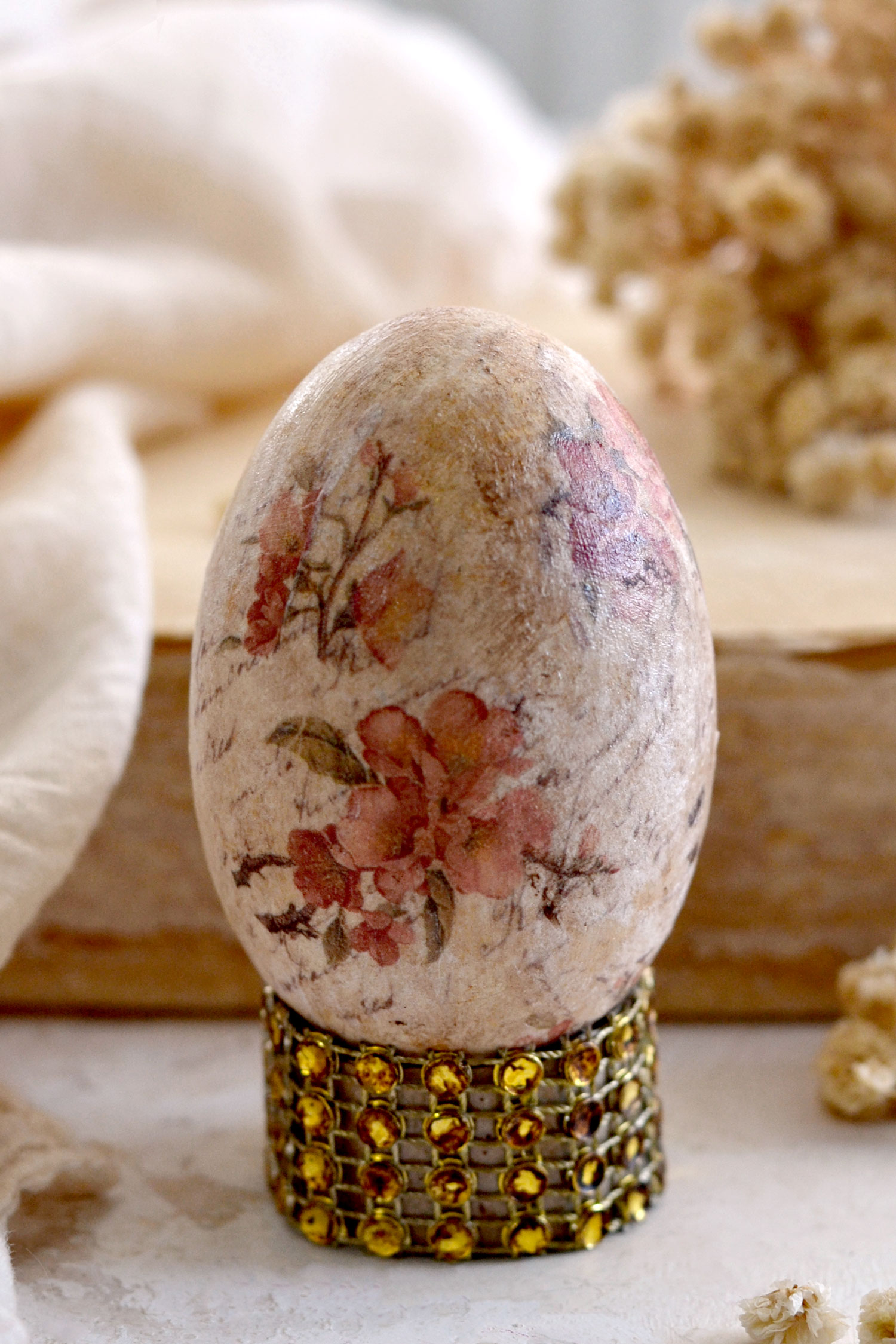
That’s it! Your quick and easy, super chic Easter egg stand will be ready in no time and will help you display your creations in a stylish way.
P.S. If you don’t have rhinestone mesh lying around, you can use the same idea to decorate the circle yourself. You can use vintage paper or even some fabric, then further embellish it with rhinestones, vintage buttons or other metallic charms.

The finished pieces look absolutely gorgeous, I was amazed at how beautifully everything came together! The decoupaged napkin with our super chic designs and the subtle aged finish that we added work perfectly together, turning these into little vintage treasures.

There are some small wrinkles and maybe even some tears here and there, but I think all these small imperfections add so much character to these beauties, making them truly unique. So even if you are new to napkin decoupage, this project is surprisingly forgiving and easy to experiment with.
I absolutely adore the eggs with the birds, but I want to show you how beautiful the ones with the flowers can look if used on their own. Either way, you’ll have plenty of options to mix and match things as you prefer, creating variation and adding even more uniqueness to your seasonal decor.

The surface of the finished pieces somehow reminds me of antique porcelain eggs. I don’t know if it was the gloss gel that I used, the gold acrylic paint or a mix between the two, but the finished pieces look astonishing. I think one of the key elements of this project is the soft aging of the surface before the design is applied. You could leave the eggs white if you prefer, but I feel that this light wash of brown and gold paint creates beautiful variations. My goal was not to create a strong distressing, but rather add a delicate vintage patina that gives the eggs a sense of age and warmth.

Because napkins are so delicate, the design blends beautifully into the surface once everything has dried. Depending on the color of your base paint, you may notice a faint difference between the napkin and the background here and there, but this actually adds to the unique, handmade look that makes decoupage so charming.
If you have any extra printed pieces left after decorating your eggs, be sure to keep them! Use a tiny box or an envelope to store them, these sheer bird and blossom images are perfect for other small decoupage projects. They would look lovely on tags, small boxes, ornaments, handmade cards, or even junk journals or mixed media projects. You can use them for Easter or spring projects, but since they are quite universal, they can also be used throughout the year!

Your super chic decoupaged eggs can be used in many ways around your home, bringing a little bit of handmade charm to your Easter decorating. They would look beautiful arranged in a bowl or plate as part of a seasonal centerpiece. You can also display them in small nests, tuck them into Easter baskets, or place them on decorative egg stands for a more elegant display.\
I hope you enjoy making this Homemade Easter Craft as much as I did, it’s such a lovely way to bring a little bit of spring into our homes!

Here’s one more display idea for your pretty handmade decorated eggs! Try displaying them in vintage Milk glass vases or other small glass containers. If the opening of the container is too big, just stuff some shredded paper in them to hold them up!
Happy crafting,
Diana | Dreams Factory


Connie Griffin says
These are just beautiful, love the vintage look to them!
Karen says
They’re perfect for crafts!
Suzanne says
These are lovely 💖 Did you decoupage around the entire egg, or just the “top” or front side? thank you for sharing and in such great detail. Looking forward to trying this project!